
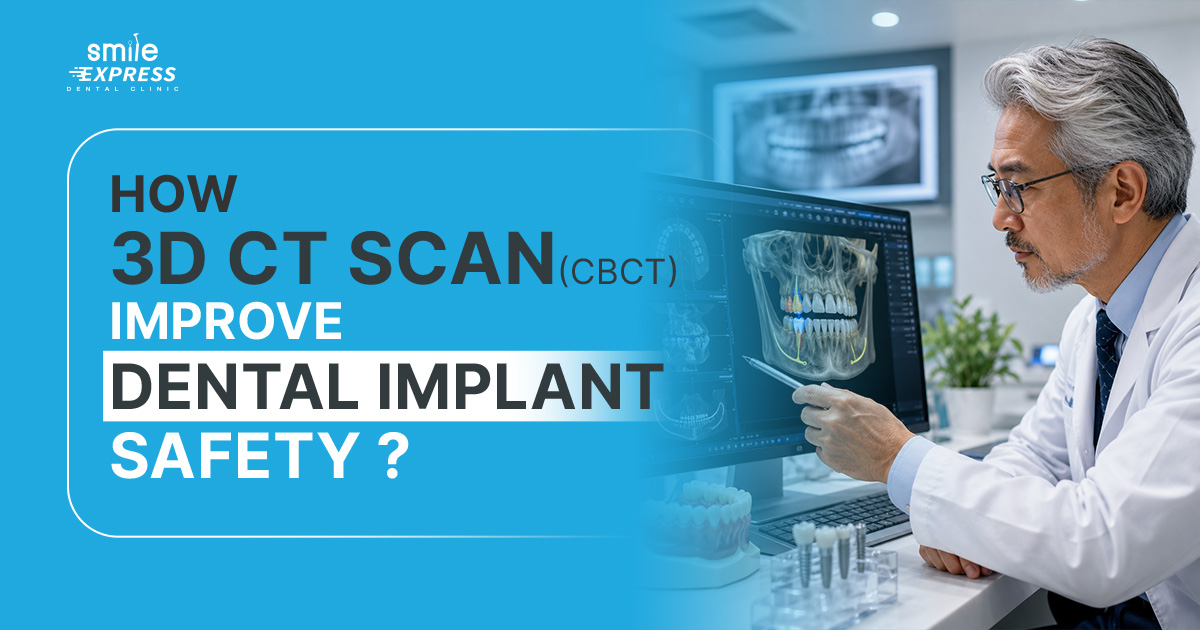
Dental implant success is not determined only at the moment of surgery—it begins long before treatment starts. One of the most important advances in modern implant dentistry is the use of 3D CBCT imaging (Cone Beam Computed Tomography).
For patients considering dental implants, especially international patients traveling abroad for treatment, understanding how CBCT technology improves safety can help increase confidence in the treatment process.
Why Traditional 2D X-Rays Are Often Not Enough
For comprehensive implant treatment, traditional panoramic X-rays have limitations.
While panoramic X-rays provide a useful overview of the mouth, they convert three-dimensional anatomy into a two-dimensional image.
As a result:
- Bone width cannot be measured accurately
- Depth perception is limited
- Nerve positions may be less precise
- Complex anatomical structures can be difficult to evaluate
For straightforward cases, panoramic imaging may provide sufficient information. However, for more complex implant procedures, relying solely on 2D imaging can increase uncertainty during treatment planning.
How CBCT Improves Implant Planning Accuracy
CBCT technology provides a detailed three-dimensional view of the patient’s anatomy.
This allows dentists to evaluate:
- Bone height
- Bone width
- Bone density
- Nerve location
- Sinus position
- Available implant space
With more accurate information, implant placement can be planned with greater precision.
Digital Treatment Planning
CBCT data can be integrated with digital planning software to support:
- Surgical guide fabrication
- Prosthetically driven implant positioning
- Computer-assisted implant placement
- Precise implant angulation
- Accurate depth control
These technologies help improve the alignment between implant placement and the final restoration.
Does CBCT Reduce Dental Implant Failure?
CBCT cannot eliminate every risk associated with dental implant treatment.
However, it can significantly reduce preventable errors by improving:
- Position accuracy
- Bone assessment
- Anatomical awareness
- Surgical planning
Better planning helps reduce the likelihood of:
- Misaligned implants
- Poor load distribution
- Nerve injury
- Early mechanical complications
In implant dentistry, predictable planning often contributes to more predictable long-term outcomes.
Radiation Safety: Is CBCT Safe?
Many patients are concerned about radiation exposure.
CBCT scans generally involve more radiation than a standard dental X-ray but significantly less radiation than a conventional medical CT scan.
When used appropriately and only when clinically necessary, CBCT is considered a safe and valuable diagnostic tool.
Responsible dental clinics use CBCT selectively rather than routinely for every patient.
The diagnostic benefits often outweigh the small additional radiation exposure when planning complex implant treatment.
Why CBCT Matters Even More for International Patients
CBCT is particularly valuable for patients traveling abroad for dental implants.
International patients often face additional challenges such as:
- Limited treatment time
- Long travel distances
- Fewer opportunities for repeat visits
- Greater need for predictable treatment planning
By improving diagnostic accuracy before surgery, CBCT helps reduce the likelihood of:
- Unexpected procedures
- Surgical complications
- Extended treatment timelines
- Additional travel requirements
This increased predictability can be especially important when coordinating treatment around international travel plans.
When Is CBCT Most Strongly Recommended?
CBCT is commonly recommended for:
- Multiple dental implants
- All-on-4 treatment
- Full-arch rehabilitation
- Severe bone loss cases
- Bone grafting procedures
- Previous implant failure
- Cases close to major nerves
- Cases involving the sinus area
- Complex anatomical situations
For straightforward implant cases, the decision to use CBCT should be based on clinical judgement and individual patient needs.
Seeing Clearly Before Surgery Matters
Dental implant safety begins with accurate diagnosis.
CBCT technology has significantly improved the ability to visualize anatomy, plan implant placement precisely, and reduce avoidable complications.
While technology does not replace clinical expertise, combining advanced imaging with experienced treatment planning helps improve safety and predictability.
For patients considering dental implants abroad, CBCT evaluation represents an important step toward making treatment more predictable, efficient, and successful.
Book an Online Consultation
Considering dental implants in Thailand? Our dental team can review your X-rays, discuss whether CBCT imaging may be beneficial for your case, and help you understand your treatment options before you travel: https://www.dentalsmilebangkok.com/contact-us/